Apis Horologica
Mechanical Hymenoptera, in a jar
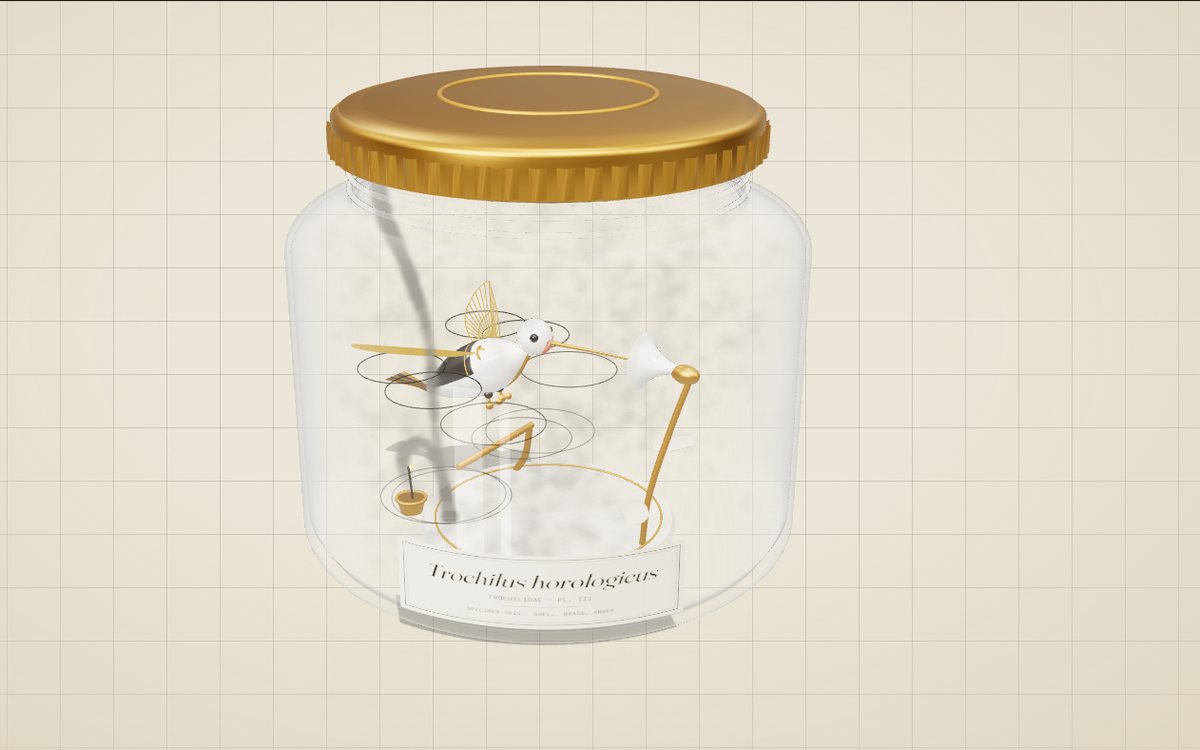
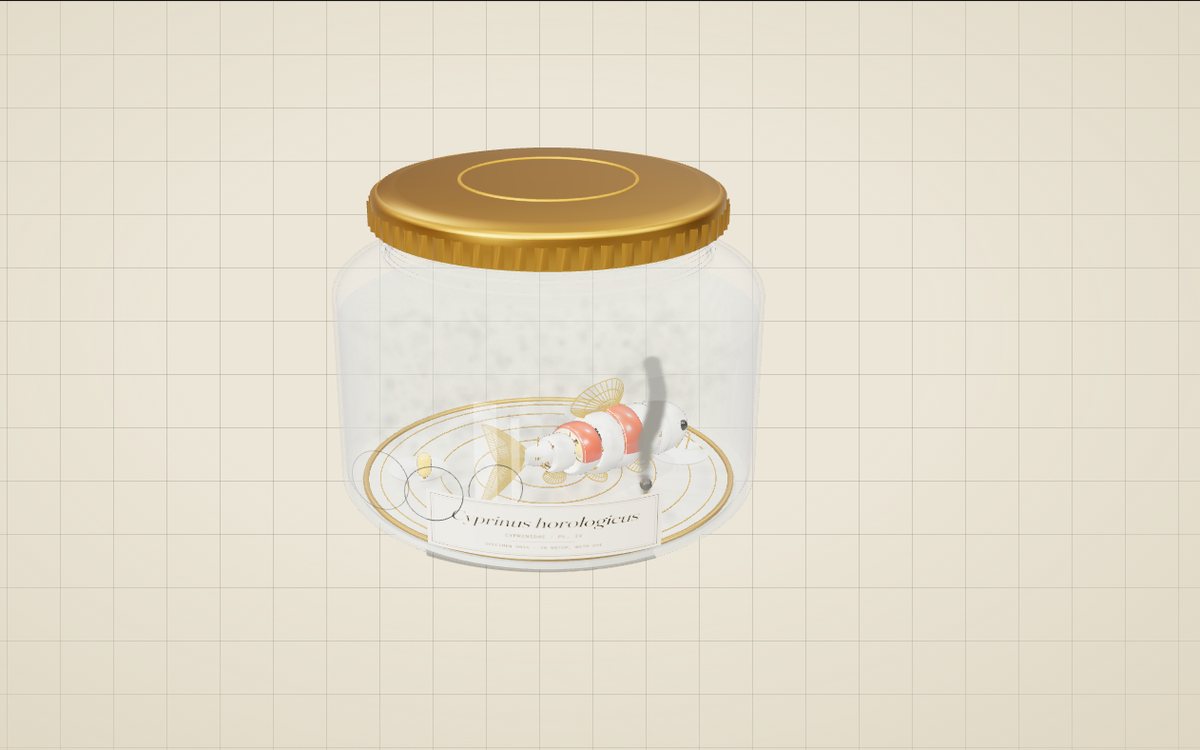
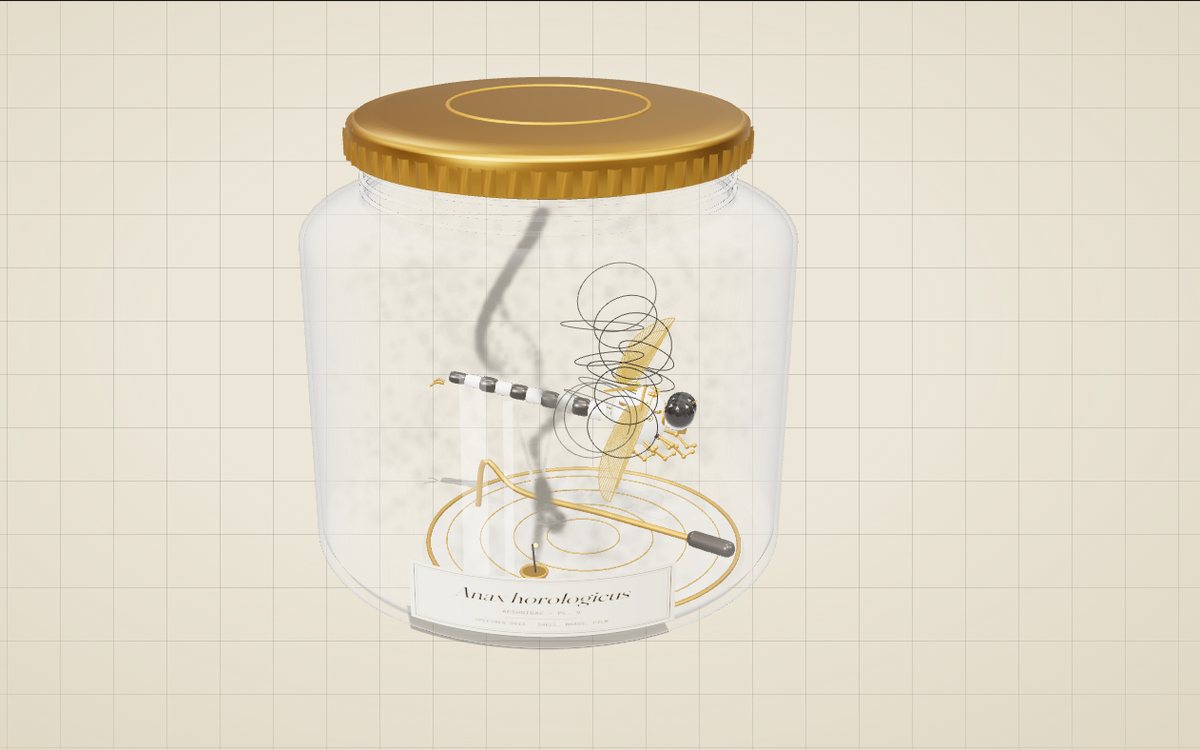
A clockwork honeybee in a sealed glass jar full of smoke. Set it flying and watch what the wings do to the air, or pick any part to read about it.
- Beat
- 0.0 Hz
- Downwash
- 0.0 cm/s
- Rings
- 0.0
- Hdg
- 000°
Drag to turn it. Pinch to zoom. Tap a part to read about it.Drag to orbit · Ctrl + scroll to zoom · click a part to focus it · keys: 1–5 views, E explode, F take flight, M material, S schematic, V vortices
Loading the 3D viewA honeybee under glass.
The same clockwork honeybee, shut in a wide glass jar under a metal lid and surrounded by smoke. Nothing in the jar moves except the bee, so every curl of smoke is the work of a wing.
A specimen jar is a way of making something small and fast keepable. This one keeps the air as well as the animal: a bee's wake is gone in a fraction of a second outdoors, and here it hangs in the smoke long enough to read.
Lift the lid
Slide from Assembled to Exploded. The jar rises off, the lid lifts away and the smoke thins and drifts out, then the bee comes apart as before.
Set it flying
Take flight and the haze starts to move. Each downstroke throws a ring of spinning smoke at the pad, and between strokes the rings settle into one steady downwash. That column of air is what holds the bee up.
Show the vortices
Turn on Vortices to draw each ring of spinning air as it is shed, and bring the Smoke slider down until only the rings are left to follow.
What the wings do to the air
A wing lifts a bee by throwing air downwards. On the downstroke the wing pushes hard and a pocket of air leaves it as a ring of spinning smoke, a vortex ring, which sinks to the floor of the jar and rolls out across the pad. On the upstroke the wing turns edge-on and slips back through the air, pushing far less, so the two strokes do not cancel. What is left at the end of every beat is a steady downwash.
There are four wings, so there are four streams. The hindwings beat into air the forewings have only just stirred, which is why the smoke under the thorax is the most tangled. Turn on the vortices and you can count the rings as they leave.
About the pictureThe smoke follows a simplified model of the wake: a jet from each wing while it moves, plus a vortex ring shed each time the stroke turns. It shows the shape of the idea, not a measured flow.
What every piece is for.
- 01
Glass Jar
Clear glass, thick at the heel
A wide-mouthed specimen jar with a rounded shoulder, thick at the base and thinner up the wall. It keeps the air inside still, so the only thing that moves the smoke is the creature.
- 02
Metal Lid
Turned metal · knurled rim · rubber gasket
A turned metal lid with a fluted rim and a rubber gasket under it. Shut, it seals the jar. Lift it, and the smoke is free to leave.
- 03
Cranial Housing
Glazed shell · brass collar
A two-part glazed capsule that carries the eyes, the antennae and the feeding tube. It turns on a brass collar, so the whole head can nod while the body holds still.
- 04
Compound Eyes
Faceted smoked glass
Two domes cut into flat facets, in the spirit of the thousands of tiny lenses in a real bee's eye: the world seen as a mosaic rather than a single picture.
- 05
Ocellar Triad
Polished brass beads
Three small beads on the crown of the head. Real bees use these simple eyes to judge the light level and keep the horizon steady in flight.
- 06
Antennae
Drawn brass wire
Two sprung wires that curve forward and end in small bulbs. In a living bee they smell, taste and feel; here they sway with the wing beat.
- 07
Proboscis
Rolled brass tube
A narrow tube folded under the head and unrolled to drink. It is the part that makes the whole machine plausible as a pollinator.
- 08
Scutum & Scutellum
Gilded cap
The domed cap over the thorax. It lifts off like a watch case to show the motor underneath, and is the part most people lean in towards first.
- 09
Thorax Shell
Glazed shell
The cradle that holds the flight motor and anchors every wing and leg. In a real bee the flight muscles fill almost all of it.
- 10
Resonant Flight Motor
Brass gears · coiled spring
Two meshed gears and a coiled spring. The spring stores energy and releases it twice a stroke, which is how an insect beats its wings faster than any muscle can twitch.
- 11
Wing Hinges
Machined brass
Four small pivots, one at each wing root. A real wing turns on a tiny elastic hinge, which lets the motor simply push while the wing finds its own angle.
- 12
Forewings
Iridescent film · brass veins
The larger pair, stretched on a brass vein frame with a thin iridescent film. In flight the two wing pairs hook together and beat as one surface.
- 13
Hindwings
Iridescent film · brass veins
The smaller pair. A row of tiny hooks locks each one to the forewing in front of it, a trick real bees use to turn two wings into one.
- 14
Tergite Rings
Banded shell plates
Five overlapping plates that make the abdomen. They telescope into one another, which is how the body can flex and swell without a single seam showing.
- 15
Amber Core
Backlit amber glass
A warm glass heart at the centre of the abdomen. It is the only light source in the machine, and the reason the whole body glows faintly from inside.
- 16
Comb Reservoir
Hexagonal brass cells
A small cluster of six-sided cells where nectar would be carried. Hexagons waste no space, which is why bees, and this bee, build with them.
- 17
Sting Assembly
Tapered brass
A single tapered needle at the tail. It is decorative here, and held in a small sheath, because this is a bee that only wants to be looked at.
- 18
Forelegs
Jointed brass limbs
The front pair, held forward in flight to keep the head clean and tucked back when landing so they can grip first.
- 19
Midlegs
Jointed brass limbs
The middle pair carries most of the weight on the landing pad. Every leg has four joints, and every joint is a separate piece.
- 20
Hindlegs & Corbiculae
Jointed brass · amber baskets
The longest pair, each fitted with a small amber basket. Real bees pack pollen into these and carry it home.