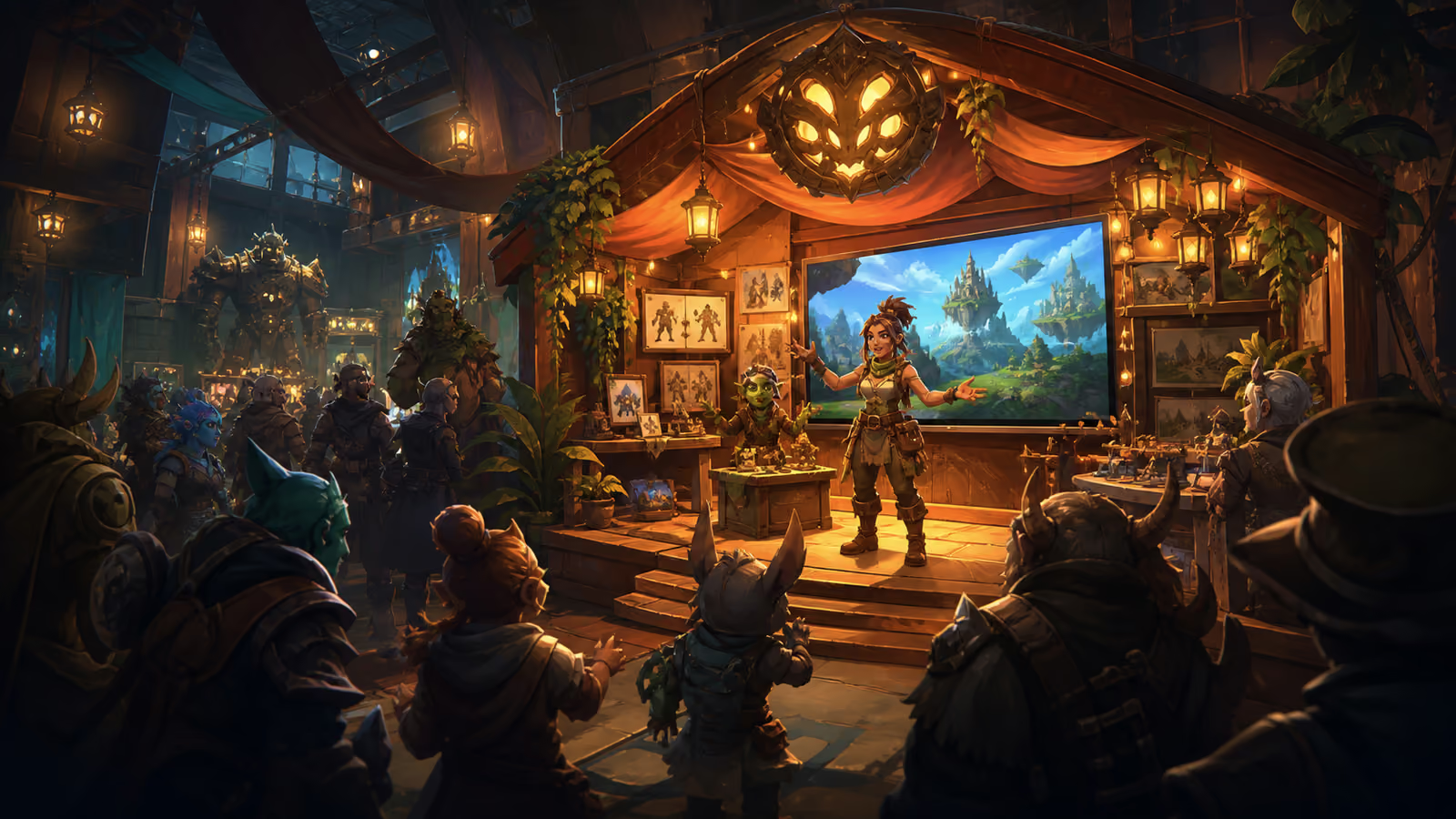
Everybody at a trade show is walking down the aisle at the same speed, avoiding eye contact, and deciding in roughly two seconds whether to stop.
Almost every stand gives them the same reasons not to: a screen showing a loop nobody watches, a bowl of sweets, and three people in matching shirts standing in a row at the front like a customs checkpoint.
Why people avoid stands
Not because they are uninterested. Because they expect a cost.
Stopping at a stand means entering a conversation that will be difficult to leave, with somebody whose job is to keep them there, about a product they may not want. The cost is social rather than financial and it is entirely real.
Everything that works removes that cost.
Let them engage without committing. Something they can do or look at that does not require speaking to anybody. Once somebody has stopped voluntarily, a conversation is easy. Getting them to stop is the hard part.
Make leaving easy. Counterintuitive and important. A stand people can leave is a stand people will enter.
Do not stand in a row. Sit down, or be busy with something. A row of people facing the aisle is read as a gauntlet.
The giveaway problem
Branded pens attract everybody. That is exactly the problem.
A bowl of free items produces a crowd of people who wanted a free item, which looks like traffic and generates no qualified conversations. Worse, it occupies the stand with people who are not prospects while the people who are walk past.
Two better structures.
Fewer, better, and earned. One genuinely good item, given to people you have actually spoken to. It costs the same in total and it means something.
Something sent afterwards. Which gives a real reason to exchange details and gives you a second contact after the show, when everybody else's branded pen is in a bin.
What to put on the stand
Every one of these is designed around the same constraint: somebody should be able to engage with it, and then leave, without having to get past a person first.
Somebody visibly doing something at the front
The most effective draw available is a person having a mildly good time, because it is rare on an exhibition floor. Whatever the activity, it belongs at the aisle edge where it can be seen, not at the back where it has to be discovered.
Genuinely good coffee, made properly
Conference coffee is uniformly poor and everybody at the show knows it. A real machine and somebody who can use it draws a queue, and a queue is a line of people standing still next to your stand with nothing to do.
Chairs and charging, advertised as such
Say it on the sign. By the middle of the afternoon a sizeable proportion of the hall wants to sit down and has a phone at eleven per cent. Offering that with no strings attached buys goodwill and a captive fifteen minutes.
A demo running on a loop with nobody attached to it
A screen showing the product doing the thing, from the start, forever, with no salesperson standing beside it. People will watch a demo they can walk away from and will refuse the identical one if it comes with a conversation.
One question on a wall, and a marker
A single good question, a large board, pens. It takes ten seconds, it is completely anonymous, other people's answers are the draw, and by lunchtime you have a genuine piece of research about what your market is worried about.
A physical skill game
Putting, hoops, a claw machine, a reaction timer. Traditional, faintly ridiculous, and reliably effective for the same reasons as the digital version: quick, visible, optional and self-ending.
A short scheduled talk at a fixed time
Ten minutes, on the hour, by a named person who genuinely knows something. Publish the times. It gives people a reason to return at a specific moment, which is the hardest thing to achieve on an exhibition floor.
A prize draw where the details come afterwards
Same prize, different order. Letting somebody take part first and offering the entry form second converts far better than requiring an email address before anything happens, because the first version is a game and the second is a transaction.
Something good sent afterwards, rather than given away
One genuinely good item, posted the following week. It gives a real reason to exchange details, it costs no more in total than a bowl of pens, and it produces a second contact at a moment when nobody else is in touch.
A bag drop
Unglamorous and quietly excellent. Everybody at a conference is carrying something they do not want, most halls make no provision for it, and being the stand that solved that problem is remembered longer than most demonstrations.
A one-minute game built around what you actually sell
Somebody playing something is the most effective draw on any floor, and a game that ends by itself removes the social cost of stopping. Built rather than bought, it puts your product in the thing people are queuing to try, and it gives your team an opening that is not a pitch: "did you beat it". The constraints are below and they are strict.
Give them something to do
The most reliable way to stop somebody is to give them a thing to do that takes under a minute and does not involve a salesperson.
The traditional versions are a prize draw, a puzzle, or a physical game. They work to the extent that they are genuinely quick and genuinely optional.
What matters is the shape rather than the specific activity.
Under a minute. Anything longer and people decline because they are meeting somebody at eleven.
Visible from the aisle. Somebody doing something is the advertisement. An activity hidden at the back of the stand does not draw anyone.
No sign-up first. Requiring details before playing converts it back into a transaction and most people walk on.
A natural opening at the end. The conversation should follow the activity rather than interrupt it.

A game on the stand
This is a version of the same idea that suits a stand unusually well, and it is worth being specific about why.
It is visible. Somebody playing something is the most effective draw available, because it is a person having a mildly good time, which is rare in an exhibition hall.
It is short and self-terminating. A one-minute game ends by itself, which means nobody has to extract themselves from it, which removes the social cost entirely.
It creates a leaderboard, if you want one, and a leaderboard produces the thing every stand wants and cannot manufacture: people coming back.
And it gives your team a natural opening. "Did you beat it" is a conversation starter that is not a pitch, from somebody who has already chosen to stop.
The design constraints for this use are quite specific and different from a gift build.
Under a minute. Not five. A stand game that takes five minutes occupies one person and blocks the queue.
Playable standing up, one hand, holding a bag and a coffee. That genuinely determines the controls.
No instructions. Anything requiring an explanation loses people, which is the argument in how a game teaches you to play it.
Restart instantly. No menus between attempts.
The tiers are £99 for a single level and £349 for a multi-level build. For a stand, the single level is usually right: one screen, one loop, endlessly replayable, which is a different brief from a gift and is closer to what what makes somebody open a game twice describes as a score-driven design.
Keep the branding light. A game covered in logos is an advertisement people decline to play. Your name at the start and the end is enough, and it is remembered better precisely because the middle was enjoyable.
The follow-up is the point
A stand generates conversations and conversations decay quickly. Almost every exhibitor knows this and almost none act on it.
The single highest-value change is to follow up within forty-eight hours, referencing something specific from the conversation. A week later, in a template, is a message nobody reads.
If you have something to send, that becomes the reason for the follow-up rather than the follow-up needing a reason. A link to the game somebody played on the stand, with their score in it, is a message that gets opened.
What this means
Remove the social cost of stopping. That is the whole design problem.
Give away less, to fewer people, better.
And follow up in two days, specifically. Most of the value of a show is created after it.
For internal events rather than trade shows, corporate event entertainment ideas covers a related set of problems.