Remote team building has a bad reputation and it has earned it. Virtual escape rooms, quizzes that overrun, an hour of everybody watching one extrovert enjoy themselves while eleven people wait for it to end.
The problem is not that it is online. It is three specific design failures, and all three are fixable.
Failure one: it is compulsory
A social event that is required is not a social event. It is a meeting with worse content.
The moment attendance is expected, everybody who would not have chosen it is in the room, resenting it, and their reluctance is visible to everybody who is enjoying themselves, which spoils it for them too.
Genuinely optional is harder than it sounds, because "optional" with the head of department watching who turns up is not optional. It requires the person running it to say out loud that nobody is counting, and then to demonstrably not count.
The corollary is that an optional event with six people who want to be there is a success, and a compulsory one with thirty is not.
Failure two: it requires performing
Most remote team activities ask people to be entertaining on camera in front of colleagues. Quizzes with buzzers, games where you act something out, anything with a spotlight that moves round the group.
That suits perhaps a third of any team and is actively unpleasant for another third. The quiet third are not shy about work; they are unwilling to be funny on demand in front of people they report to, which is an entirely reasonable position.
The activities that work let people participate at their own level. Watching counts. Contributing one thing counts. Turning the camera off counts.
Failure three: it is scheduled into a full day
An hour of team building dropped into a day that already contained eight hours of work is an hour of work moved to the evening.
If it matters, it should displace something. Say what it displaces. A session that comes with "and the Thursday stand-up is cancelled this week" is received completely differently from one that does not.
And it should be in work hours. Evening events exclude everybody with caring responsibilities, which is a specific and identifiable group, and it turns a perk into unpaid time.
Optional, in work hours, and built for the quiet third
That is the entire selection criterion, and it is why not one of them requires anybody to be entertaining on camera in front of colleagues.
Anything with an artefact at the end
Something that exists afterwards outperforms an hour that evaporates. A recipe book from the team, a map of where everybody actually is, a playlist, a written history. It also lets people contribute in their own time rather than live on camera.
Small groups, rotated
Four people talk. Twenty people take turns waiting. Splitting a large session into fours and reshuffling them does more for how a team feels than any single activity performed in front of everybody.
A rotating pair, booked automatically
Two randomly matched people, twenty minutes, no agenda, arranged by something other than a person. The automation matters: nobody has to decide to reach out, which is the step that never happens.
Something physical, arriving on the same day
A distributed team never shares a room, and a package landing at everybody's house on the same morning is one of the few things that produces a genuinely simultaneous experience. Good coffee, lunch, or the components of something.
An asynchronous competition with a leaderboard
A photograph challenge, a step count, a puzzle, a score to beat. It runs for a week rather than an hour, people join at their own level, and nobody has to be entertaining on camera to take part.
Protected overlapping hours with no agenda
Two hours a week where the whole team is online and nothing is scheduled. It recreates the only thing an office does that a call cannot, which is unplanned proximity, and it costs nothing but the discipline of leaving it empty.
A show and tell where watching counts
Somebody demonstrates something they made, from work or not. The rule that makes it work is that there is no rota: presenting is volunteered, and turning up to watch is full participation.
A budget to meet whoever is nearby
Most distributed teams contain several people within an hour of each other who have never met. A standing budget for lunch, claimed without approval, produces more real connection per pound than any organised offsite.
Anything designed around the newest person
Remote work is hardest on new starters, who have no incidental contact and no way to learn who does what. An activity built so that the person who joined in March is not at a disadvantage is usually better for everybody.
A game with the whole team in it, opened in their own time
No shared room, no camera and no scheduled hour, which is a rare combination and the reason this suits a distributed team better than a co-located one. Everybody opens the same link wherever they are, and the quiet third get to enjoy it alone at their desk at eleven at night.
A commissioned game for a distributed team
This is a category that suits remote teams better than co-located ones, which is unusual.
The reason is that it requires no shared room. Everybody opens the same link, wherever they are, at whatever time suits them, and the shared experience is the content rather than the scheduling.
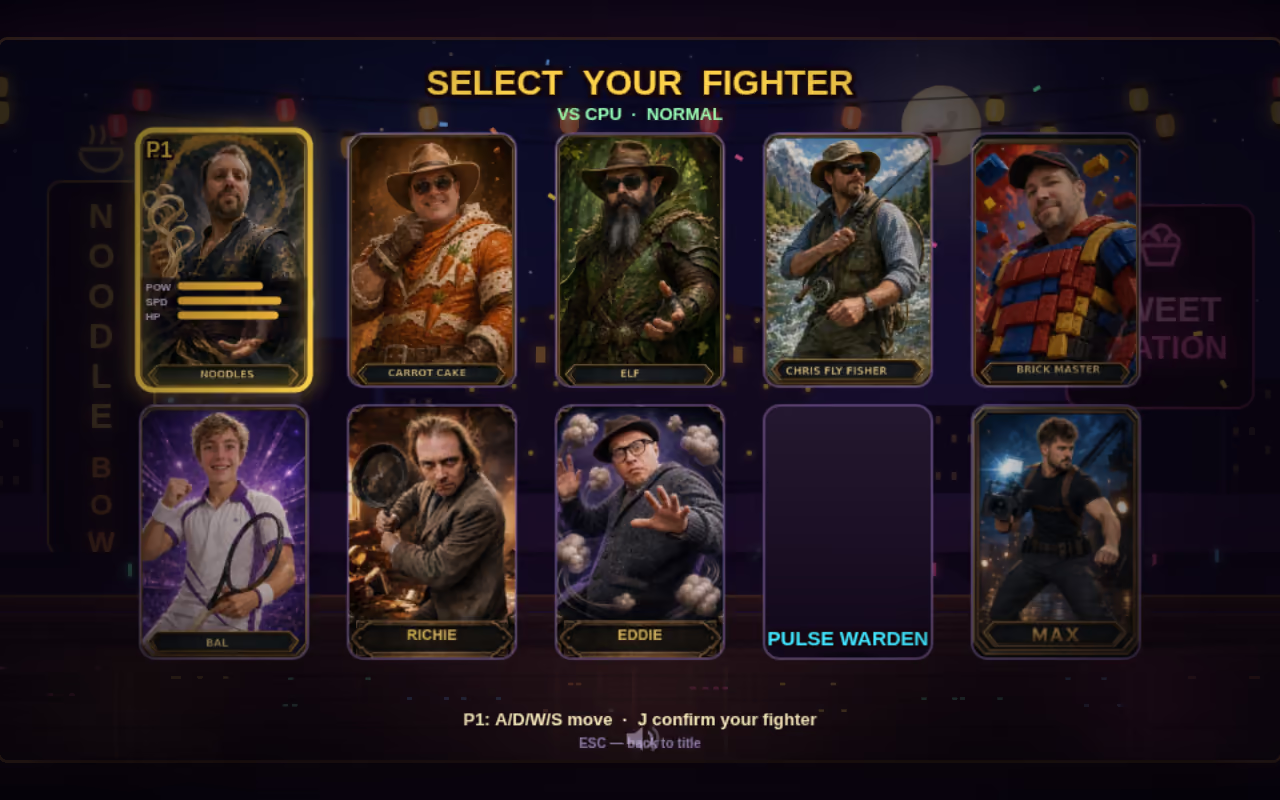
What makes it work is that everybody is in it. The whole team painted from photographs as characters, the office or the product as levels, the recurring jokes as the level names. It is not an activity to attend, it is a thing that exists and gets discovered.
The quiet third are covered properly here in a way they are not by a quiz: they can open it alone, at their desk, at eleven at night, and enjoy being in it without performing for anybody. That is the same principle that makes this work for corporate events generally, discussed in corporate event entertainment ideas.
The cast is what drives the tier: £99 for a single level and a small team, £349 for a multi-level build with a proper cast. Keep it short, for the reasons in how long a custom game should take to finish, because a team game that takes forty minutes is a thing people feel obliged to finish.
One caution worth taking seriously: photographs of staff need their agreement. Ask individually rather than announcing it, and let people decline without explaining, because somebody may have a reason they do not want to share.
What to avoid
Anything with forced participation.
Anything in the evening.
Anything requiring a costume.
Anything where the CEO is watching who turns up.
Icebreakers involving personal disclosure. Two truths and a lie is a fine game between friends and an intrusion between colleagues at different levels of seniority.
What this means
Optional, in work hours, and short.
Design for the quiet third, because the loud third will enjoy anything.
And leave something behind. An artefact beats an event, every time, for a team that does not share a building.